Week 6: October 14, 2024
This blog is an ongoing project for Professor Ryan Enos' Election Analytics Course at Harvard College (GOV 1347, Fall 2024). It will be updated weekly with posts analyzing how different features impact the likelihood of Kamala Harris (D) or Donald Trump (R) winning the 2024 U.S. Presidential Election or winning specific states in the election. The blog will culminate in a final predictive model for the outcome of the general election.Context & Question
The focus of this week's post is campaign advertising. I decided to do a callback to the post from September 30th and investigate the difference between incumbent candidates and challenger candidates when it comes to advertising. Do ad tones change for incumbent candidates and challengers? Are the tones of advertisements markedly different for successful candidates versus unsuccessful ones?Exploratory Analysis
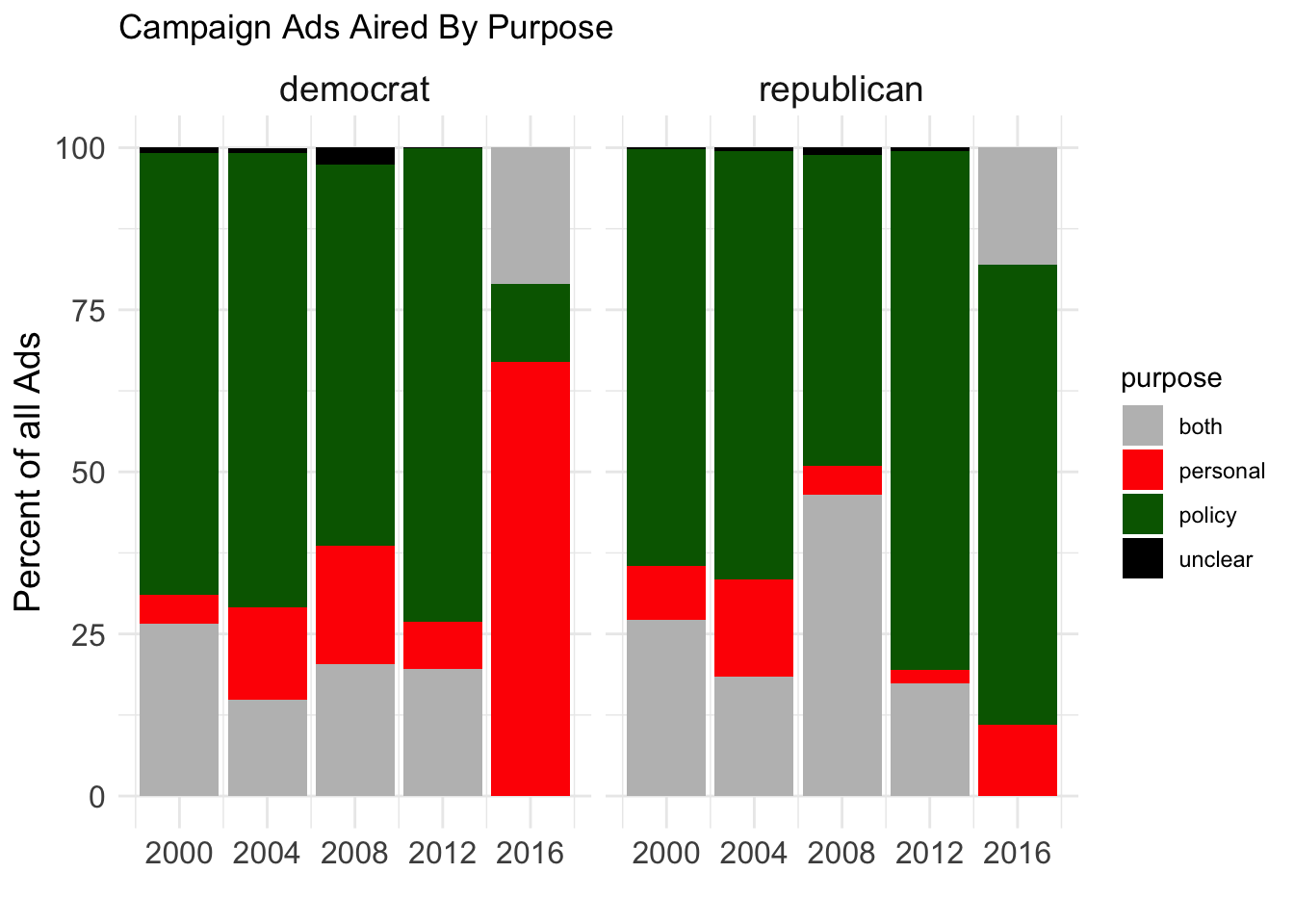
Before I investigate the relationships between ad tone and incumbency, I want to expose some of the trends in campaign ads since the 2000 election.First we can get an idea of why campaigns run ads. The following plot shows the distributions of campaign motives for Democratic and Republican candidates in the elections between 200 and 2016. Candidates could run “personal,” versus “policy,” versus “other” ads. Both parties’ candidates tended to air ads that focused on policy, a trend that was broken in 2016 when candidate Donald Trump devoted a significant majority of his advertising to personal issues/causes.
## Joining with `by = join_by(creative, party, cycle)`
## `summarise()` has grouped output by 'cycle', 'party'. You can override using
## the `.groups` argument.
Next, I wonder how ad tone corresponds to candidate success. Below are two plots, one showing the ad tones of all winning candidates in elections since 2000 and one showing the tones of all losing candidates since 2000. Ad tones were classified as “attacking” one’s opponent, “promoting” oneself, or “contrasting” oneself with the opponent in this dataset.
## `summarise()` has grouped output by 'cycle', 'winner'. You can override using
## the `.groups` argument.
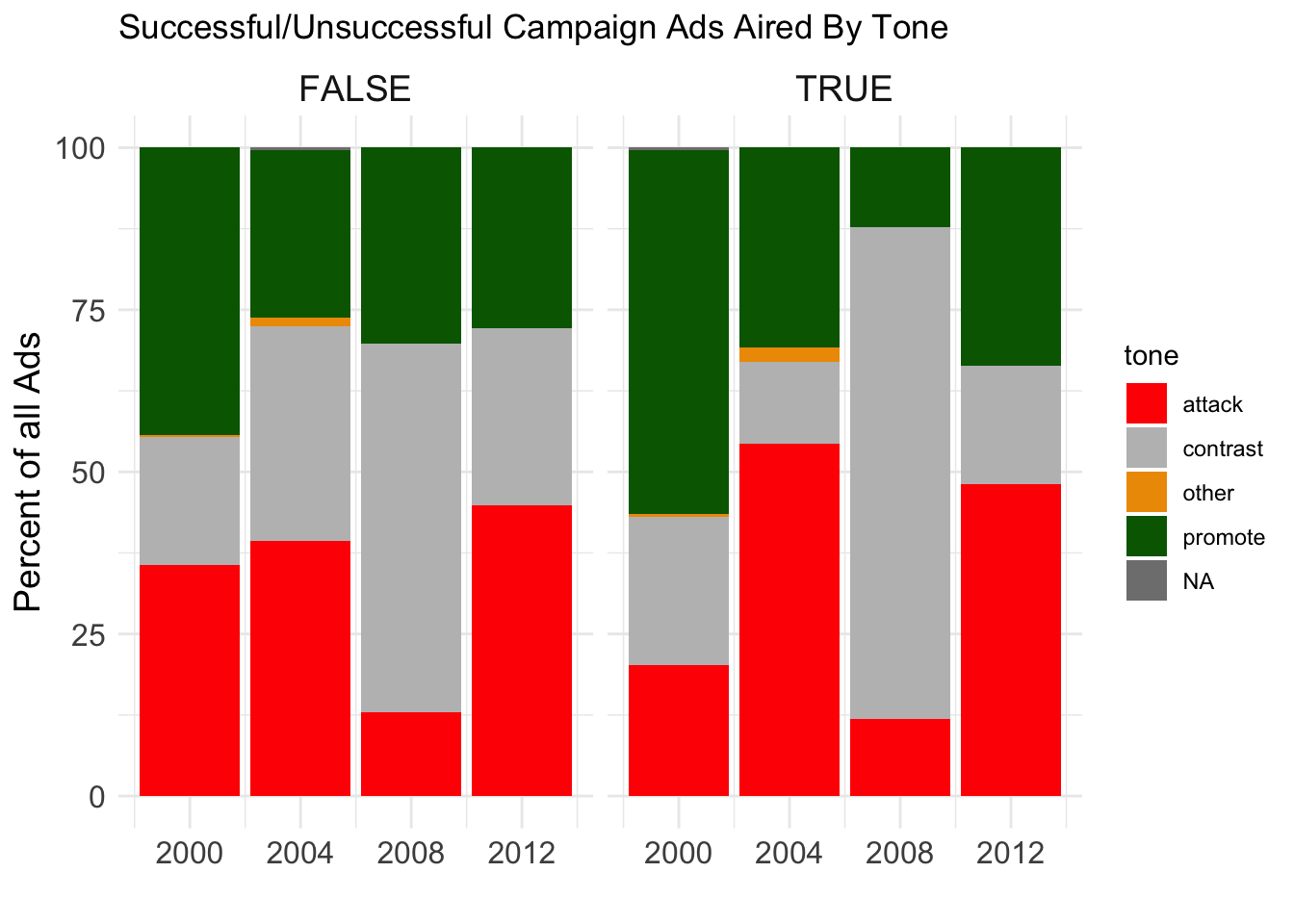
As we can see the 2004 and 2012 elections were marked by attacks whereas the 2008 election was largely contrast ads. The most promotional ads were in the 2000 election. One limitation with this data is that it only contains information about ad tones from the elections between 2000 and 2012. However, as we saw in the previous plot, the 2016 election represented a shift in ad motivation, and it’s likely that that may have corresponded to a shift in ad tone (i.e. “personal” ads may be more likely to be “attacking” or “promoting” for a certain candidate than “policy” ads or “other” ads).
Incorporating Incumbency
I decided to investigate how incumbency influences a candidate's tone in advertisements. Given that incumbent candidates have the advantage of 4-years of publicity and media spotlight that their opponents do not, I though that may manifest difference in ad tone. Further, incumbent candidates sometimes run on different issues that challengers (e.g. many presidents running for a first term focus on domestic politics while many running for reelection focus on foreign policy). Different issues may be more partial/conducive to different ad tones. Lastly, incumbent candidates probably have an advantage in portraying the previous four years in a very positive light while challengers likely have an advantage in pointing out its problems. This would seem to correspond quite directly to ad tone.## `summarise()` has grouped output by 'cycle', 'incumbent'. You can override
## using the `.groups` argument.
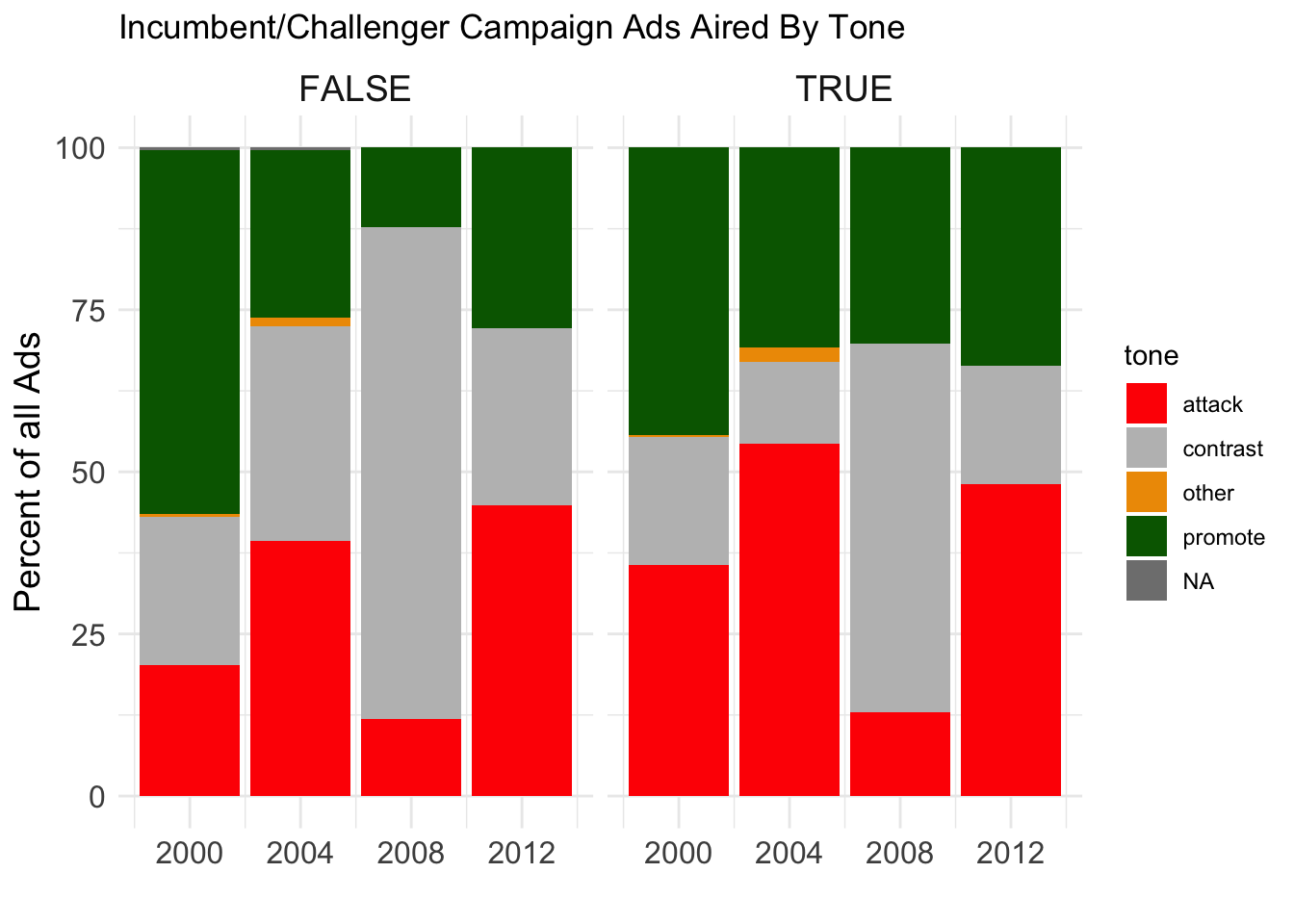
Some of the individual bars in the plot above are the same as those from the plot looking at successful/unsuccessful ad tones, but these are divided by whether the candidate was an incumbent or not. For example, since the incumbent was successful in 2004, the 2004 bar under the ‘incumbent TRUE’ plot here is the same as the 2004 bar under the ‘successful TRUE’ bar on the previous plot.
As expected, the portions of “promoting ads” were greater for incumbent candidates than challengers between 2000 and 2012. Surprisingly, the portions of attacking ads were relatively equal, or at least they changed together (i.e. an incumbent did not attack a challenger more than they got attacked in any given election between 2000 and 2012–rates of attacks between the candidates were approximately symmetrical). The difference then is made up in “contrasting” advertisements, of which challenger candidates tended to run more.
The decrease in attacks in the 2008 election between Barack Obama and John McCain is interesting. This was the first election that an African American candidate won, and it’s plausible that both candidates strayed away from attacks to avoid allegations that they were made on the basis of race.